
THE NOVEL
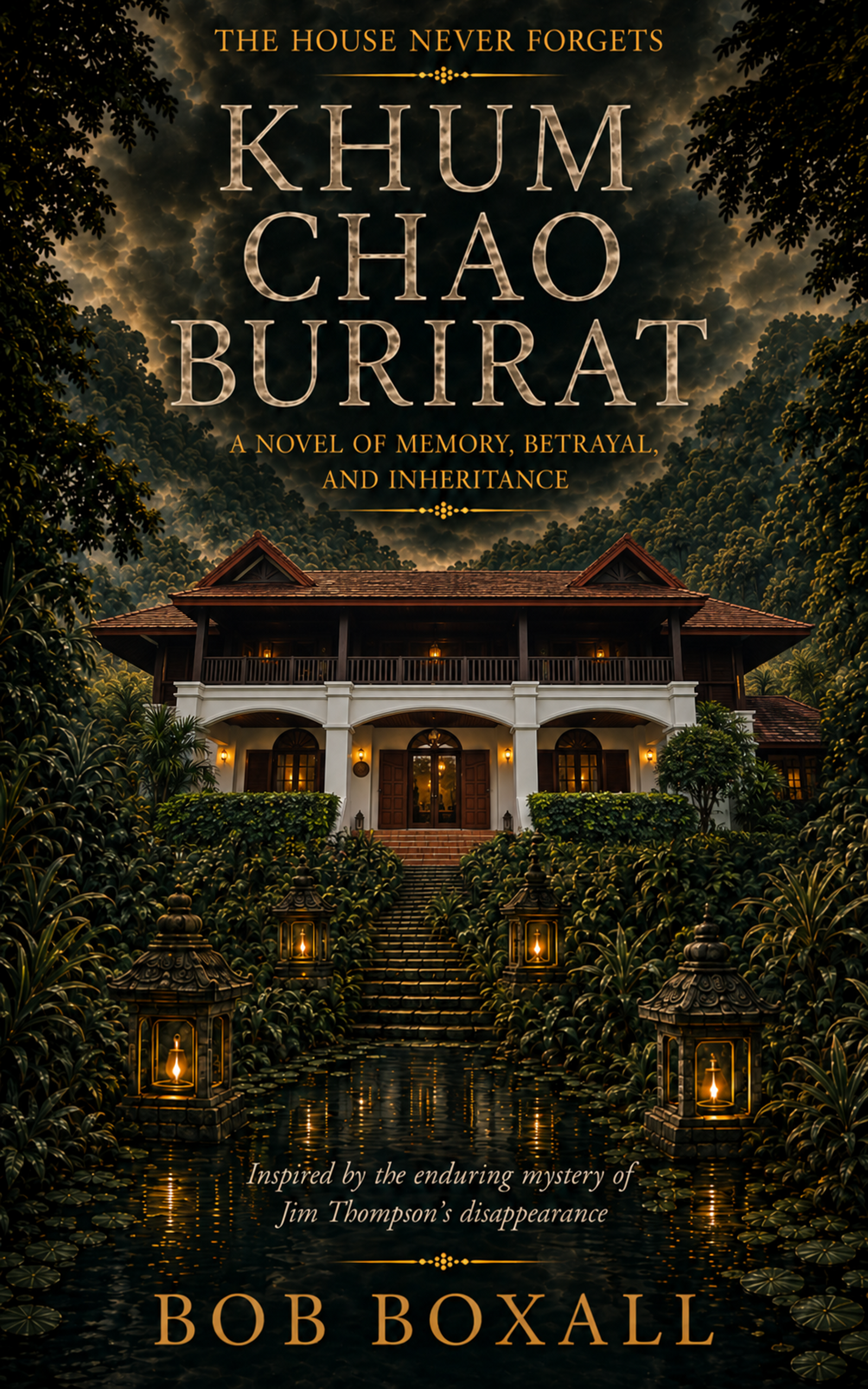
Khum Chao Burirat
The House Never Forgets
Easter Sunday, 1967. In the mist-bound Cameron Highlands, American silk magnate Jim Thompson receives five typed words from a past he believed buried:
MAE ON. THE ARCHIVE SURVIVED.Twenty-one years earlier, in the mountains east of Chiang Mai, Jim had entered Khum Chao Burirat—a secluded Lanna estate overlooking a black reservoir. Beneath the house lay an archive protected by seven Keepers, a hidden inheritance and a history powerful men were prepared to kill to possess.
Now the message is calling him back.
As Jim returns to Northern Thailand, the boundaries between memory, record and truth begin to fracture. Old loyalties surface. The dead refuse to remain silent. And the house at Mae On reveals that it has preserved far more than the secrets entrusted to it.
Inspired by the enduring mystery surrounding Jim Thompson’s disappearance, Khum Chao Burirat is a historical mystery of memory, betrayal and inheritance—an atmospheric journey through post-war Thailand, the final years of colonial Malaya and a house that never forgets.
COMING SOON
READ AN EXTRACT
From Chapter One: Easter Sunday
Cameron Highlands, Malaysia
Easter Sunday, 26 March 1967
Moonlight Bungalow sat high above Tanah Rata, on a ridge of trimmed lawn, tea bushes and old Malayan damp. It was one of those hill houses built for escape by men who never quite understood that history travels with you regardless, folded into the luggage like a second, heavier set of clothes.
Its white railings had begun to chalk at the edges. Black timber had swollen soft through sixty seasons of rain. A wide veranda looked out across the valley beneath a roof that had weathered heat, occupation, rumour and the small indignities of peace—which Jim Thompson had long since decided was often harder on a house than war.
A small board beside the gate read MOONLIGHT in hand-painted letters, the paint still fairly fresh. The house had carried another name before the Emergency, something French connected to the mining company that built it in the thirties. It had been renamed during the years of curfew and ambush, when naming something after moonlight was about the most optimistic act available to a man.
The road climbed through greenery so carefully maintained that it had become another kind of wilderness—a wilderness with better manners. Beyond the clipped edges, the jungle pressed close, dark and unhurried, biding whatever time jungle bides. Vines thickened in the shade. Ferns held beads of water like something hoarded. The earth steamed faintly wherever the thin sun touched it.
Jim had seen houses like this before: rest houses, planters’ retreats, temporary refuges for men who had built their lives on the assumption of staying, only to discover, usually too late, that nothing in this part of the world had ever agreed to that arrangement.
A house was never merely a house. Jim knew that better than most.
His own home in Bangkok had begun as architecture and become something closer to biography: six old teak houses dismantled and carried to Soi Kasemsan 2, raised again beside Khlong Saen Saep and facing the weaving community whose hands had helped make him rich.
Ayutthaya timber. Ban Krua memory.
Buddhist paintings and Khmer torsos stood alongside blue-and-white porcelain—ginger jars and dragon-patterned chargers in lacquered cabinets, bowls arranged upon carved consoles with the quiet authority of objects that had outlasted every dynasty that made them. A great sandstone Buddha sat on a teak dais in the entrance hall, eyes closed, hands folded, having seen enough not to bother greatly with the present. Manuscript paintings climbed the stairwell wall, their pigments still vivid after centuries, while gilded deities watched from orange-lit niches beside the main doorways.
Beneath it all lay silence—the particular silence of a house built, however unconsciously, to keep something in as much as to keep something out.
Visitors called it beautiful. They were not wrong. But beauty could hide arrangement, arrangement could hide intention, and intention—maintained for long enough—could become a trap. A man might build one for himself so carefully and so beautifully that he could live inside it for years without noticing the shape of the cage.
By noon, the mist had burned away from the valley. Sunlight struck the tea fields with a clean brightness that made the morning’s unease feel almost theatrical, the kind of thing a man might dismiss over lunch if only his pulse would agree.
Lunch was laid on Moonlight’s veranda: roast lamb, rich and faintly smoky in the hill air; potatoes; mint sauce; bread; butter softening too quickly in the sudden warmth; gin beading cold against the glass. It was the domestic theatre of empire, staged in the hills of a country that had never belonged to the people who built verandas like this one—staged so convincingly that the performers themselves appeared to have forgotten it was a performance.
Conversation moved lightly around the table: plantation gossip, Singapore politics, the price of imported goods, the new and uneasy shape of Malaysia, rumours from Bangkok. Diplomats were mentioned, and a road washed out by rain. Everyday concerns were discussed with such determined normality that Jim found himself admiring the sheer effort it must take to keep a life sounding ordinary.
He barely heard any of it.
His fork lay untouched, the lamb cooling on his plate. His drink sweated beside it, a ring of condensation spreading slowly across the white cloth.
Sometimes, in company, Jim could summon the familiar version of himself: charming, amused, exacting and opinionated about colour, proportion and food. The Jim Thompson people expected. The man who talked about Thai silk as though the fabric held a nation’s soul; who turned dinner tables into salons; who convinced editors, generals and princesses alike that they had personally discovered something ancient and refined.
But that day the mask would not sit correctly. It rested askew, and feeling it there was almost worse than not wearing it at all.
The man in the pale jacket stood behind his eyes, motionless among the pines, waiting for Jim to blink so that he might step forward again.
Matthew Keene.
Dead twenty-one years. Dead in smoke and jungle, in the wreckage of a plane Jim had watched burn so brightly against the dark canopy that certain shades of orange still turned his stomach. Dead beneath stone and water. Dead because some men had to remain dead if the living were going to manage.
Jim had built an entire life upon that single fact, brick by careful brick.
Now, in one thinning moment of mist, it was threatening to come apart.